
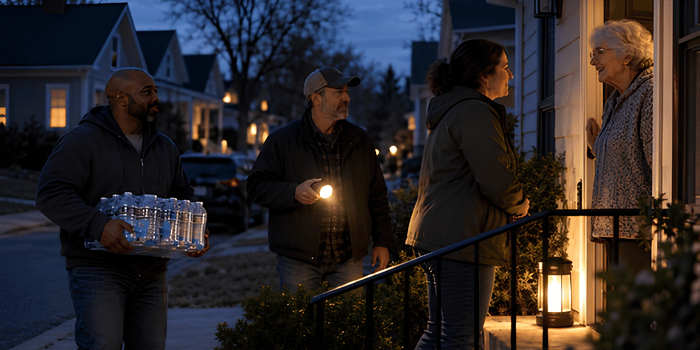
Church leaders do not need to predict the next emergency to know that one will eventually test the congregation. A winter outage, flood, wildfire, cyberattack or supply disruption can quickly turn routine pastoral needs into urgent ones.
Across Europe, governments are asking citizens to prepare for that reality. The European Commission's Preparedness Union strategy calls for guidelines that would help the population remain self-sufficient for at least 72 hours. Germany's civil-protection agency recommends enough food and drink for 10 days. Sweden tells households to plan for at least a week.
The message is simple: help may not arrive immediately. For a pastor, that raises a ministry question. Which members can manage for three days, and which ones may be in danger after three hours?
Preparedness Is A Pastoral-Care Issue
The public recommendations are practical. In the United States, Ready.gov’s Build a Kit guidance encourages households to assemble emergency supplies, including water, nonperishable food, a flashlight, batteries, first-aid items and essential medications. The European Union emphasizes a three-day minimum. Germany's Federal Office of Civil Protection and Disaster Assistance advises households to stock 10 days of familiar food and roughly 14 liters of liquid per person for each week. Swedish guidance includes food, water, medicine, cash, a battery radio, power banks and important phone numbers on paper.
Pastors can reinforce those steps without becoming alarmist. A pantry cannot stop a storm, but it can keep a short disruption from becoming an immediate crisis. A flashlight matters when the grid fails. Medication matters when roads are blocked. A written contact list matters when the phone holding every number is dead.
Yet household checklists do not tell a church which older member lives alone, which family lacks transportation, whose medical device needs power or which volunteer has first-aid training. Supplies answer, "What do I have?" Pastoral readiness asks, "Who is likely to need care?"
A Pantry Is Not A Ministry Plan
Emergencies expose needs you can't store on a shelf. Who checks on the homebound member when the heat stops? Who contacts families when a service is canceled? Who has a generator, a first-aid kit or medical training? Which building can safely receive people, and who has authority to open it?
Sweden's 2025 household-preparedness guidance goes beyond batteries and bottled water. It tells citizens to get to know their neighbors, discuss how they can help one another and talk about useful skills. A congregation can do that work intentionally instead of waiting for a crisis to reveal its gaps.
A church plan does not need to become an elaborate command center. It does need named leaders, current contact information, a process for identifying vulnerable members, backup communication channels and clarity about what the church can and cannot safely provide.
The Church Is Already A Local Network
A congregation already contains much of what resilience requires. It gathers people across ages, neighborhoods and occupations. It includes caregivers, tradespeople, nurses, teachers, drivers and families who understand local needs.
The missing piece is often coordination. A membership database may be current, but relationships may not be. Small groups may know their own people well while no one sees needs across the whole church. Announcements may depend on one channel that fails with the power or cellular network.
Prepared well, a church can use small-group leaders and ministry teams as a distributed care network. Leaders can share verified information, check on assigned households and route needs to people equipped to help. The goal is not institutional control. It is making sure no one disappears because everyone assumed someone else had called.
Lead Without Feeding Fear
Biblical preparedness is not panic disguised as wisdom. Joseph stored grain before famine. Proverbs praises the prudent person who sees danger and takes refuge. The early believers shared resources so needs did not remain invisible among them.
None of those examples treats fear as a virtue. Church leaders should prepare what can be prepared, refuse sensationalism, and teach members to serve beyond their own households. Readiness should make a congregation calmer and more generous, not more suspicious.
A useful church plan begins simply. Assign responsibility. Keep contact information current. Identify members who may need an early check-in. Map useful skills without publishing private vulnerabilities. Decide how you'll communicate service changes and urgent needs. Practice once before the warning arrives.
The strongest ministry asset may be trust built in advance. When ordinary systems go quiet, a church that already knows its people can move from concern to care.
About ActsSocial
ActsSocial gives every church a free page for service times, sermons, prayer requests, events and giving links, plus small groups, reading plans and discipleship touchpoints. Church leaders can communicate with followers while real names and human moderation keep congregation life clear of engagement-driven noise. ActsSocial does not replace emergency alerts or first responders, but it helps churches strengthen the relationships that make coordinated care possible. Built on Acts 2:42–47, it is free for churches and members. Get your free page by clicking here.